Introduction
Automotive welding demands consistent quality, precise coordination and reliable cycle control. As automobile manufacturing moves towards connected and flexible production, robotic welding cells must coordinate robots, field devices, distributed I/O and operator interfaces without adding unnecessary complexity.
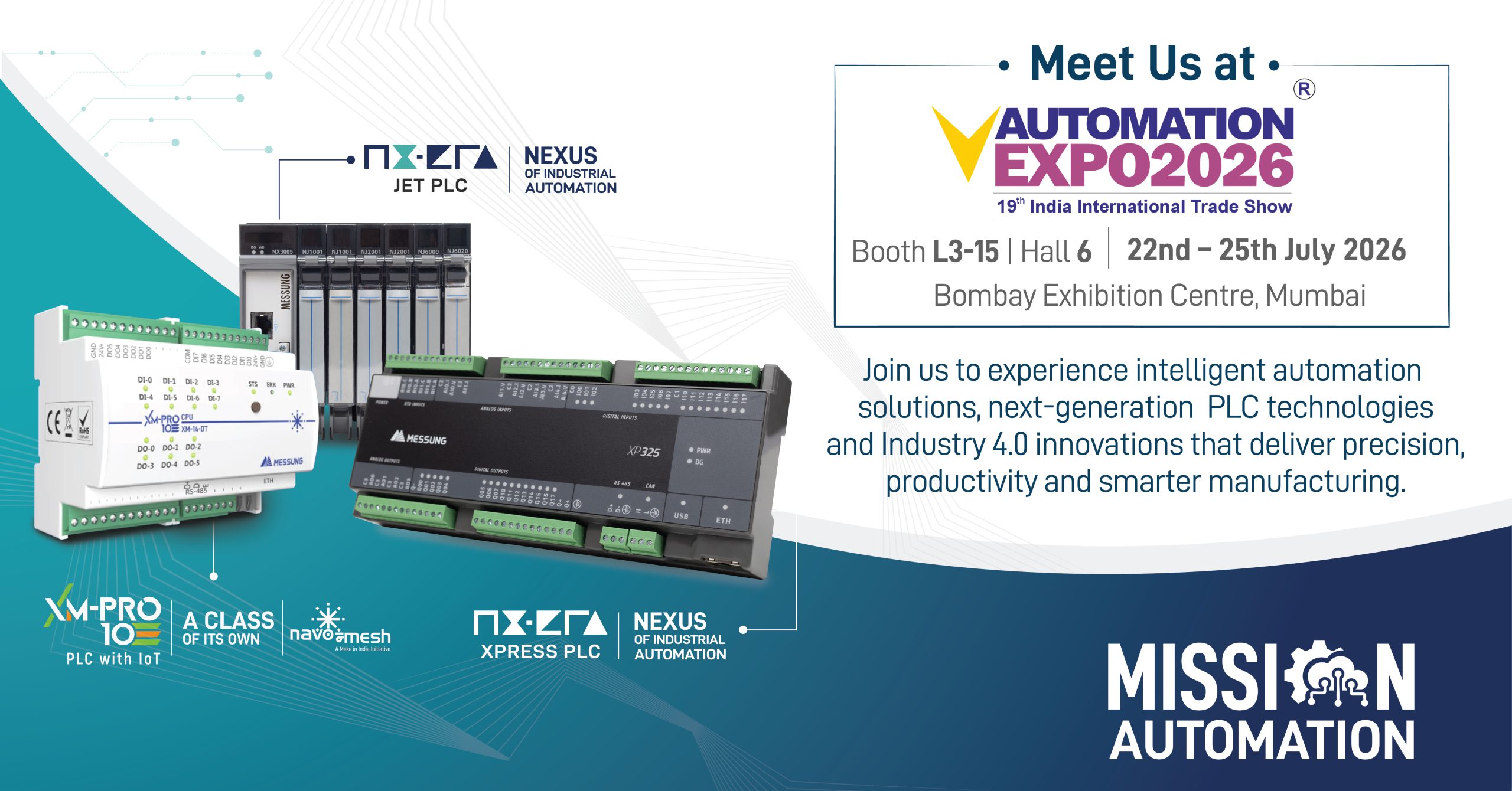
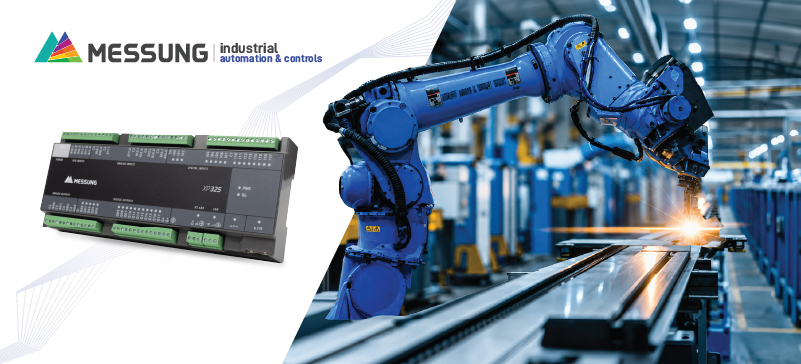
This is where PLC automation provides a structured and dependable approach. A smart robotic welding cell was developed using the NX-ERA XPRESS PLC, integrated with CANopen remote I/O stations and an HMI. The PLC communicates with welding robots through the EtherNet/IP protocol, while individual CANopen remote stations manage distributed digital I/O across the cell.
This architecture enables centralised control, distributed field-level connectivity and practical operator monitoring. The NX-ERA XPRESS is a compact PLC with expansion capability through CANopen remote I/O, making it suitable for small, scalable industrial automation applications.
The Challenge of Automotive Welding
Automotive welding cells involve multiple machines and devices that must operate in a defined sequence. Robots, sensors, actuators, fixtures, safety devices and operator interfaces must exchange signals accurately to maintain smooth production.
The control system must therefore:
● Coordinate the PLC with robotic systems through an industrial communication network.
● Establish reliable communication between the PLC and robots using EtherNet/IP.
● Manage distributed digital inputs and outputs through individual CANopen remote stations.
● Provide operators with a clear HMI interface for machine operation and monitoring.
● Maintain smooth coordination between different elements of the robotic welding cell.
Conventional centralised wiring can require long cable runs from every field device to a single control panel. A distributed architecture places remote I/O stations closer to the relevant equipment, helping simplify field connections and support a more organised machine layout.
NX-ERA XPRESS PLC-Based Solution
The NX-ERA XPRESS PLC was selected as the central controller for the robotic welding cell. As a smart controller, it coordinates the sequence of operations and manages signal exchange between the robotic systems, field devices and HMI.
The PLC communicates with the welding robots through EtherNet/IP. This industrial Ethernet connection allows the control system and robots to exchange the signals required for coordinated operation, including sequence commands, status information and process-related interlocks.
For field-level control, individual CANopen remote DI/DO stations are distributed across the cell. These stations collect digital inputs from sensors and transmit digital outputs to actuators and other connected devices. The arrangement supports a flexible network architecture while reducing the requirement to route every field connection to the central panel.
The system architecture includes:
● NX-ERA XPRESS PLC as the central control platform.
● EtherNet/IP communication between the PLC and robots.
● Individual CANopen remote DI/DO stations for distributed field I/O.
● HMI for operator interaction and system monitoring.
● Coordinated control of the robotic welding cell through a central PLC architecture.
The result is an integrated arrangement of key plc components working together within one automation system.
How the Robotic Welding Cell Works
The NX-ERA XPRESS PLC manages the operating sequence of the cell. Once the component is positioned and the required conditions are confirmed, the PLC communicates with the robot controller through EtherNet/IP.
The robotic system then performs the programmed welding operation. During the cycle, the PLC receives status signals and monitors the machine sequence through the distributed CANopen I/O stations. Inputs may include fixture confirmation, component presence, safety status and cycle-completion signals. Outputs can control clamps, indicators, valves and other field devices.
The HMI enables operators to start or stop the process, monitor machine status, view alarms and identify the current stage of the welding cycle. This improves operator interaction and makes troubleshooting more convenient.
Results and Key Outcomes
The automation architecture provides a structured way to manage communication and control across the robotic welding cell.
Centralised control
The NX-ERA XPRESS PLC acts as the main controller, coordinating robot commands, field signals, sequence logic and operating conditions.
Integrated robot communication
EtherNet/IP enables communication between the PLC and robotic systems, supporting coordinated operation within the welding cell.
Distributed I/O architecture
Individual CANopen remote stations allow digital inputs and outputs to be distributed across the machine or cell. This can help simplify wiring and make the control architecture easier to organise.
Improved operator interaction
The HMI provides an accessible interface for operating and monitoring the system. Operators can receive process information and respond to alarms more effectively.
Scalable control architecture
The combination of Ethernet-based robot communication and distributed CANopen I/O supports a flexible automation setup. Additional devices or I/O points can be considered according to application requirements.
Why PLC Automation Matters
Modern programmable controllers are used for sequencing, monitoring, interlocking and machine control across industrial applications. In automotive production, programmable logic controllers help coordinate repetitive and high-speed processes while supporting consistent operation.
A compact PLC such as the NX-ERA XPRESS can be appropriate for a dedicated robotic cell where space, control requirements and expandability must be balanced. It can also serve as a practical PLC for automation in machine-building applications.
Depending on project requirements, automation systems may integrate PLC I/O Modules, HMI devices, drives, sensors, robots and safety components. Other PLC communication protocols, including Modbus, may be used in suitable architectures to connect compatible devices. PID controllers can support applications involving temperature, pressure, flow or other continuous process variables.
With the growth of IOT and IIOT, PLC-based machines can also become part of connected IOT systems. Production information, alarms, operating data and maintenance insights can be made available to higher-level monitoring or manufacturing systems. Robotics, data platforms and advanced automation solutions can further extend the capabilities of a connected production environment.
For automotive OEMs and machine builders evaluating PLC manufacturers in India, selecting the right controller should involve more than comparing size or price. Important considerations include I/O capacity, communication options, programming flexibility, environmental suitability, diagnostics, scalability and technical support.
Conclusion
The smart robotic welding cell demonstrates how a well-structured PLC and communication architecture can bring different automation components together in an automotive manufacturing environment.
With the NX-ERA XPRESS PLC at the centre, EtherNet/IP for robot communication, CANopen remote DI/DO stations for distributed field control and an HMI for operator interaction, the solution provides a practical and organised approach to controlling robotic welding applications.
This architecture can be particularly valuable for automotive OEMs and machine builders seeking connected, distributed and reliable robotic automation systems. It also shows how a compact PLC, when selected and configured according to application requirements, can support scalable and efficient industrial automation.
It coordinates robots, distributed I/O, field devices and HMI functions for smooth, sequenced welding operations.
The NX-ERA XPRESS PLC communicates with welding robots through the EtherNet/IP industrial communication protocol.
They distribute digital inputs and outputs across the welding cell, simplifying field wiring and supporting flexible machine layouts.
The HMI enables operators to start, monitor and control the process while viewing machine status and alarms.
It provides centralised control, integrated robot communication, distributed I/O, improved monitoring and scalable automation.