The global textile manufacturing industry is undergoing a massive transformation, driven by rapid technological advancements and evolving market demands. From raw fiber processing to intricate yarn dyeing and high-speed fabric weaving, every phase of production is being re-engineered to deliver maximum productivity, zero-defect quality, and shortened cycle times. In this fast-paced industrial ecosystem, traditional manufacturing methods can no longer keep up. The need for precise control, reduced energy consumption, and minimal operational downtime has made advanced automation, specifically through industrial-grade Programmable Logic Controllers (PLCs) which are the cornerstone of modern textile production.
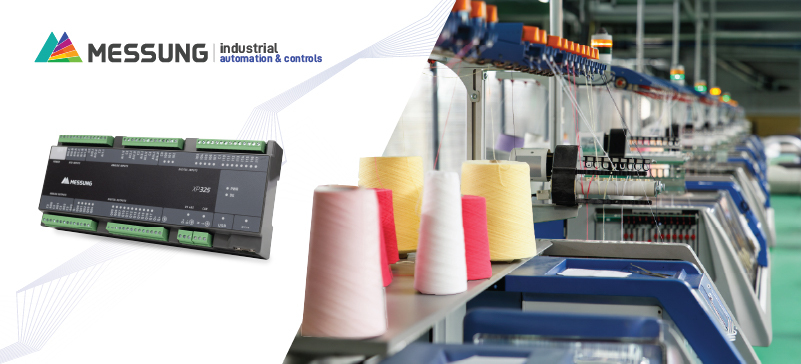
At Messung Industrial Automation, we bring decades of pioneer heritage and industry-leading expertise to this technological revolution. Understanding the distinct operational nuances of the textile value chain, we engineered the NX-ERA Xpress PLC a compact, high-performance controller designed to combine flexibility, computational power, and energy efficiency.
In this article, we explore how the NX-ERA Xpress PLC transforms textile machinery operations, lowers manufacturing costs, and accelerates the transition toward smart, Industry 4.0-ready mills.
The Central Role of PLCs Across the Textile Value Chain
Textile manufacturing is a multi-stage process where every phase requires precise execution. PLCs serve as the central nervous system across the two primary automation-intensive stages: Cotton-to-Yarn and Yarn-to-Fabric.
1. Cotton-to-Yarn Processing
From initial ginning and bale plucking to carding, drawframe, combing, ring frame machines, and autoconers, PLCs orchestrate every high-speed rotation and mechanical adjustment. In these environments, PLCs work alongside Human Machine Interfaces (HMIs), Variable Frequency Drives (VFDs), and high-precision Servo amplifiers and Servo motors to maintain ideal speed and torque control.
2. Yarn-to-Fabric & Finishing
In weaving and processing, PLCs manage warping and twisting machines alongside various loom configurations including shuttle, airjet, and rapier looms. On processing lines, PLCs regulate delicate operations such as singeing, bleaching, dyeing, and chemical finishing (to impart softness, wrinkle resistance, or water repellence). Rotary and flat-bed printing lines similarly rely on PLC-driven synchronization to keep multicolour patterns aligned.
While downstream garment manufacturing uses selective automation, Messung focuses its primary technical solutions such as the NX-ERA Xpress PLC and NX-ERA Jet PLC on these core, continuous-processing stages where precision is most critical.
Key Benefits of Integrating PLCs in Textile Operations
Upgrading textile machinery with modern PLCs delivers tangible operational gains:
● Increased Productivity: Automating manual adjustments drastically reduces machine setup time, limits unplanned downtime, and maximizes overall throughput.
● Superior Quality & Accuracy: High-precision, real-time control guarantees consistent tension, temperature, and synchronization during spinning and weaving, minimizing fabric defects.
● Real-Time Diagnostics: Continuous monitoring catches minor operational deviations before they turn into major equipment failures, ensuring sustained plant productivity.
Architectural Deep-Dive: The NX-ERA Xpress PLC
The NX-ERA Xpress PLC brings powerful performance to space-constrained control panels, answering the specific demands of modern machinery builders and plant managers.
Core Technical Features
● High-Density Digital & Analog I/O: Features a high-density I/O architecture capable of processing extensive data feeds simultaneously, ensuring fast feedback loops across dynamic textile operations.
● Codesys® Software Platform (IEC 61131 Standard): Programmed via Codesys®, an open-source, industry-standard environment. This standardization facilitates easy integration across multi-vendor equipment networks.
● Built-in Industrial Protocols: Native support for Ethernet TCP/IP, Modbus, and CANopen guarantees frictionless communication between shop-floor drives, field sensors, and main controllers.
● Industry 4.0 Connectivity: Equipped with embedded OPC-UA and MQTT standards, enabling direct, secure data bridging between field machinery, edge gateways, and enterprise management software.
● Integrated HTML Web Server: Provides remote monitoring capabilities, allowing system engineers to securely track machine health, alter parameters, and view diagnostic logs from any web browser.
Operational Advantages for Textile Manufacturers
Deploying the NX-ERA Xpress PLC translates to clear competitive advantages across the factory floor:
- Energy Efficiency: Energy is one of the highest operational costs in textile production. By optimizing motor speeds and dynamic loads in power-hungry processes like ring spinning, the NX-ERA Xpress helps lower overall power consumption.
- High-Speed Processing: Fast execution times enable instant micro-adjustments on high-speed lines, maintaining smooth production flow without lags or mechanical stress.
- Precision Control: Critical parameters such as thread tension, alignment, and chemical dosing are strictly maintained within programmed thresholds, significantly lowering material scrap.
- Scalability & Modular Growth: The modular design allows manufacturers to scale up their control architecture easily as production capacity expands over time.
- Cost-Effective Performance: Delivers advanced automation capabilities at an accessible price point, providing a quick return on investment for small, medium, and large mills alike.
Machinery Application Highlights
1. Yarn Steaming Machines
Yarn conditioning requires balancing thermal parameters, pressure, and timing. The NX-ERA Xpress PLC delivers:
● Closed-loop regulation of steam pressure and temperature for uniform conditioning.
● Automated timing control matched to different yarn densities and batch types.
● Automated material loading/unloading sequences to maximize cycle efficiency and reduce manual errors.
2. Integrated Heat Setting & Space Dyeing
Specialty dyeing requires exact thermal control and synchronized colour application. The NX-ERA Xpress manages:
● Multi-zone heat regulation to lock in dimensional stability and dye fixation.
● Precise metering during space dyeing to create intricate, repeating patterns without color bleeds.
● Coordinated material handling between sequential processing zones to prevent material bunching or stretch defects.
The Power of Messung’s Integrated Ecosystem
The NX-ERA Xpress PLC connects seamlessly with Messung’s broader industrial automation portfolio, including XM-PRO remote I/O modules. This unified ecosystem simplifies system wiring, consolidates diagnostics, and streamlines plant-wide expansion under a single, reliable support network.
Conclusion: Driving the Future of Smart Textiles
As the global textile market demands higher quality, faster turnaround times, and sustainable practices, modernizing machinery control is essential. Messung’s NX-ERA Xpress PLC provides the speed, precision, energy savings, and Industry 4.0 readiness needed to keep modern mills running smoothly. By combining compact engineering with flexible open standards, Messung empowers textile manufacturers to transform traditional production lines into smart, high-performing assets ready for tomorrow.Frequently Asked Questions
It optimizes machine control, reduces setup time, minimizes downtime, improves throughput and enables precise, real-time process management.
It supports spinning, weaving, yarn steaming, heat setting, space dyeing, finishing and other continuous textile processing operations.
Built-in OPC-UA, MQTT, Ethernet TCP/IP, Modbus and CANopen enable connected, data-driven and Industry 4.0-ready textile automation.
Yes. Optimized motor speeds and dynamic load management can reduce power consumption across energy-intensive textile machinery.
Its compact architecture, high-density I/O, CODESYS platform, modular scalability and high-speed processing deliver flexible, precise automation.