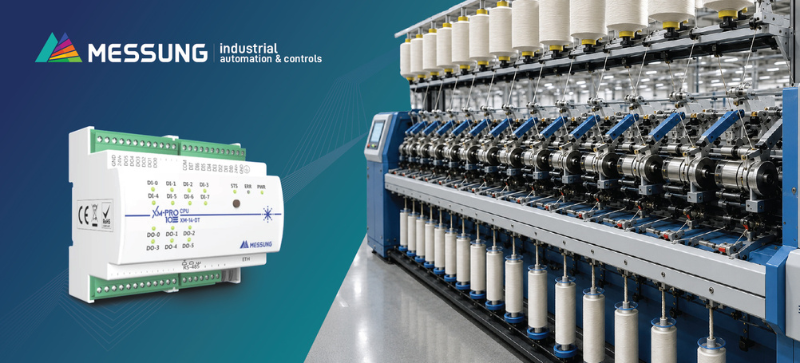
In the technical textile industry, synthetic fibre yarn twisting plays a vital role in determining the strength, uniformity, and quality of the final product. Achieving consistent twist levels while maintaining high production speeds requires precise machine control and continuous monitoring.
To enhance machine performance and reduce operator dependency, the modern synthetic fibre yarn twisting machine was automated using the XM-PRO 10 PLC, integrated with a VFD and HMI. The solution delivers accurate speed control, simplified operation and reliable process management, helping manufacturers achieve consistent yarn quality and improved production efficiency.
Why Automation Matters in Technical Fibres
Technical fibres are used in demanding applications such as automotive, marine, construction and safety equipment. These products must meet strict performance standards for tensile strength, abrasion resistance and dimensional stability. Synthetic fire yarn twisting is a critical process that directly influences these properties.
In this context, automation is not just a convenience; it is a business necessity. Manufacturers need systems that can maintain tight tolerances, adapt quickly to different technical fibre yarn specifications and minimize human error. That is where modern PLC-based control solutions, such as the XM-PRO 10 PLC, create a clear advantage.
Challenge
Textile manufacturers often face several challenges in yarn twisting operations:
● Frequent speed adjustments during production and changeovers.
● Manual intervention leading to process variations.
● Production downtime due to faults and delayed troubleshooting.
● Limited visibility into machine performance and operating parameters.
For technical fibres, these challenges translate into higher rejection rates, inconsistent product performance, and reduced customer confidence. Even small variations in twist per meter can affect the final mechanical properties of the synthetic fibre yarn, especially in high-performance applications.
Manual operations also slow down changeovers and increase the risk of incorrect settings. When faults occur, limited diagnostic information can extend downtime and disrupt production schedules. In a competitive market, these inefficiencies directly impact profitability and growth.
Solution
The machine was automated using the XM-PRO 10 PLC, VFD and HMI to create a reliable and operator-friendly control system.
The solution provides:
● Centralized machine control through the XM-PRO 10 PLC for smooth and synchronized machine operation.
● Variable speed control using the VFD to achieve the desired twist and production rate for different yarn specifications.
● Intuitive HMI interface for recipe selection, parameter setting, machine status and fault monitoring.
● Automated process sequencing to ensure stable and repeatable machine performance.
● Real-time diagnostics for faster fault identification and reduced downtime.
This architecture supports the specific needs of technical fibres, where precision, repeatability and traceability are essential. The XM-PRO 10 PLC acts as the central controller, coordinating spindle speed, traverse movement and tension control in a tightly synchronized manner.
The VFD enables fine-tuned speed regulation, allowing operators to set exact twist levels for different technical yarn counts and materials. The HMI simplifies day-to-day operations by providing clear visual feedback, easy recipe management and instant access to key parameters.
Result / Metrics
The automation solution helped improve overall machine performance by delivering:
● Consistent yarn twisting quality across production batches.
● Improved productivity with smooth and controlled machine operation.
● Reduced operator intervention through automated process control.
● Faster machine setup and product changeovers.
● Better process visibility and quicker troubleshooting, resulting in improved machine availability.
For manufacturers of technical fibres, these results mean stronger, more uniform products with fewer defects. Consistent twist quality improves tensile strength and reduces breakage during downstream processes such as braiding, weaving or fibre lay-up.
Improved productivity comes from reduced cycle variability and smoother acceleration. Automated sequencing ensures that each production run follows the same optimized pattern, regardless of operator skill level. Faster changeovers allow manufacturers to respond quickly to custom orders and shorter production runs, which are increasingly common in specialized fibre applications.
Better diagnostics also reduce unplanned downtime. When a fault occurs, the HMI displays clear error messages and relevant parameters, enabling maintenance teams to identify and resolve issues faster. This increases overall machine availability and supports more predictable production planning.
Broader Impact on the Industry
The shift toward PLC-based automation in yarn twisting aligns with broader trends in the technical fibres sector. Customers are demanding higher performance, better traceability and more consistent quality. At the same time, manufacturers are under pressure to improve efficiency and reduce waste.
Modern automation solutions like the XM-PRO 10 PLC help bridge this gap. They enable manufacturers to:
● Meet stricter quality standards for high-performance applications.
● Reduce material waste caused by off-spec yarn.
● Improve energy efficiency through optimized motor control.
● Support digitalization efforts with structured data and clear process logs.
Over time, these benefits contribute to stronger brand reputation, better customer retention and improved competitiveness in global markets.
Looking Ahead
As the technical fibres industry continues to evolve, automation will become even more central to production strategy. Future developments may include deeper integration with MES systems, predictive maintenance using sensor data and advanced analytics for process optimization.
The modern synthetic fibre yarn twisting machine automation using the XM-PRO 10 PLC represents a practical step in this direction. It shows how a well-designed control system can deliver immediate gains in quality, efficiency and reliability while laying the foundation for further digital transformation.
For manufacturers seeking to strengthen their position in the technical fibres market, such automation is no longer optional. It is a strategic investment that supports long-term growth, product excellence and operational resilience.
Frequently Asked Question
Automation ensures consistent twist quality, higher productivity, reduced operator errors, faster changeovers and better machine availability.
The solution uses XM-PRO 10 PLC, VFD for speed control with HMI for easy operation, monitoring and fault diagnostics.
Precise speed and twist control reduce variations, ensuring uniform strength, better performance and fewer defects in technical fibres.
Yes, recipe-based HMI settings and VFD control allow quick adaptation to various yarn counts, materials and twist requirements.
Real-time diagnostics and clear HMI fault messages enable faster troubleshooting, minimizing production stops and improving overall machine availability.